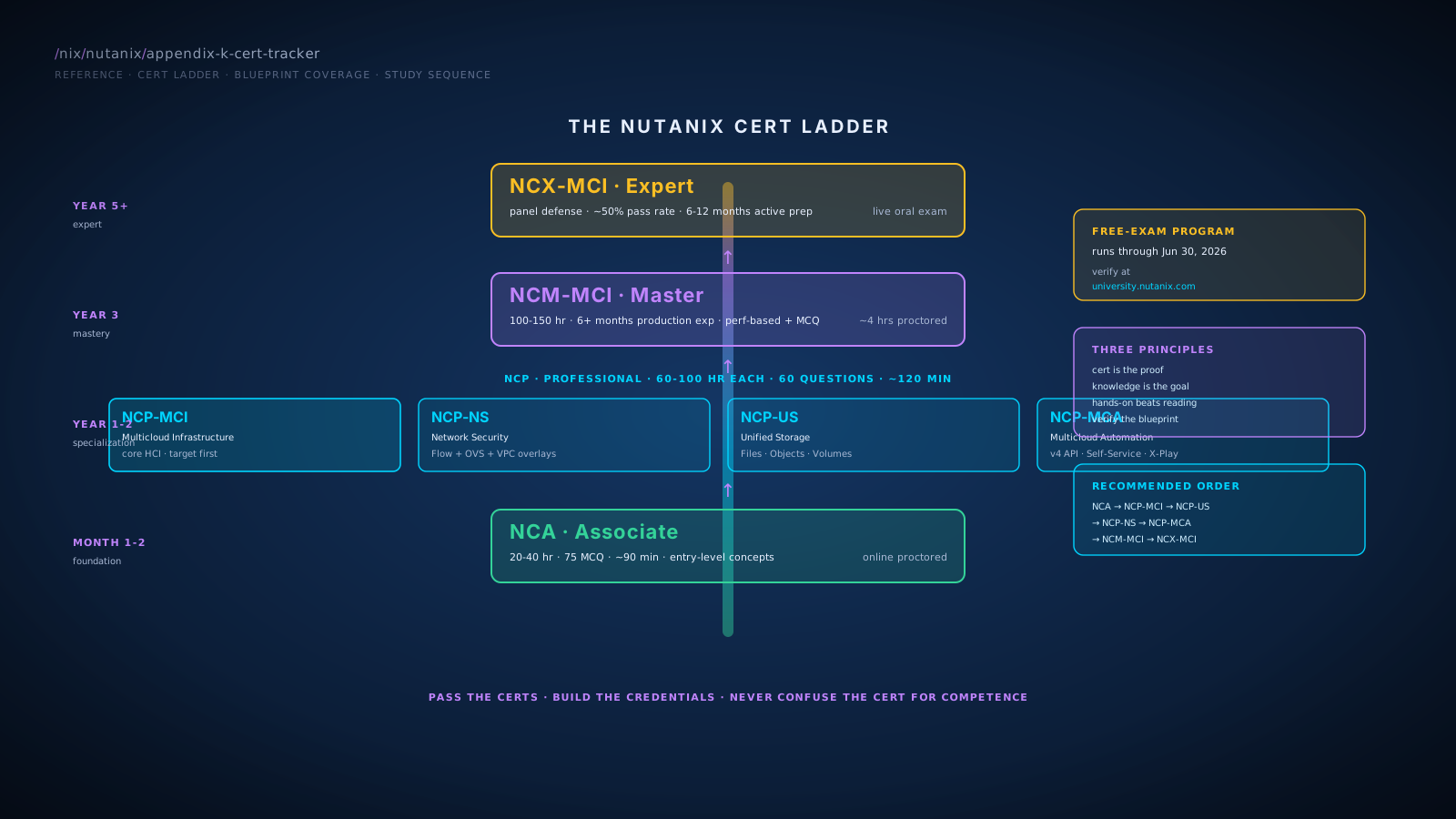
0The Nutanix Cert Ladder
Hierarchy overview
NCX-MCI    Expert         (panel defense, ~50% pass rate, 12+ months prep typical)
   ↑
NCM-MCI    Master         (deep multi-cluster design, 6+ months experience needed)
   ↑
NCP-MCI    Professional   (the core HCI cert, the one most SAs target first)
NCP-NS     Professional   (Network Security specialization)
NCP-US     Professional   (Unified Storage specialization)
NCP-MCA    Professional   (Multicloud Automation specialization)
NCP-CN     Professional   (Cloud Native / Kubernetes specialization, separate track)
   ↑
NCA        Associate      (entry-level, foundational concepts)
Each NCP specialization is independent (NCP-MCI does not require NCP-NS or NCP-US), but most SAs progress through them in the order shown. NCM and NCX both build on NCP-MCI as the foundation. NCP-CN (Cloud Native) is the outlier: it is a Kubernetes and NKP specialization on a separate track from the HCI ladder, so the HCI modules do not prepare you for it. It has its own complete study group; see section 6.
Time and effort expectations
| Cert | Typical prep time | Hands-on required | Format |
|---|---|---|---|
| NCA | 20-40 hours | Light | Multiple choice, 75 questions |
| NCP-MCI | 60-100 hours | Significant | Multiple choice + scenario, 60 questions |
| NCP-NS / NCP-US / NCP-MCA | 40-80 hours each | Moderate-significant | Multiple choice + scenario |
| NCM-MCI | 100-150 hours | Deep operational experience | Performance-based + multiple choice |
| NCX-MCI | 6-12 months active prep | Production deployment experience | Panel defense (live oral exam with senior architects) |
These are typical for someone with relevant infrastructure background (VMware, Linux, networking). Faster ramps are possible; slower ramps are common for those building infrastructure foundations alongside cert prep.
Nutanix runs periodic free-exam promotions. Verify current promotional availability at university.nutanix.com when planning your exam timing. As of writing, a free-exam program runs through June 30, 2026.
The discipline: don't rush a cert just because the exam is free. Pass it because you're ready, not because the timing is convenient.
1NCA · Nutanix Certified Associate
The entry-level cert. Validates foundational understanding of Nutanix concepts: HCI principles, the platform's components, basic operations.
- Format: ~75 multiple-choice questions, ~90 minutes, online proctored
- Audience: anyone new to Nutanix who needs to demonstrate baseline competence. SAs, sales engineers, junior infrastructure team members, customer-side staff during evaluation.
- Realistic prep: 20-40 hours for someone with general infrastructure background
Blueprint coverage map
| Blueprint domain | Weight | Curriculum coverage |
|---|---|---|
| HCI Fundamentals | ~15% | Module 1: HCI Foundations |
| Nutanix Platform Architecture | ~20% | Module 2: Architecture |
| AHV Hypervisor Basics | ~15% | Module 3: AHV (foundational sections) |
| Prism Element Basics | ~15% | Module 4: Prism (PE sections) |
| DSF Storage Basics | ~15% | Module 5: DSF (foundational sections) |
| Networking Basics | ~10% | Module 6: Networking (foundational sections) |
| Data Protection Basics | ~10% | Module 7: Data Protection (foundational sections) |
- Read Modules 1-4 in order (HCI, Architecture, AHV, Prism)
- Skim Modules 5-7 for foundational concepts (don't dive deep yet)
- Complete Lab Exercises in Modules 1-4
- Review the practice questions in those modules (target 80%+ on the knowledge MCQs)
- Read Appendix A: Glossary end-to-end
- Take the Nutanix-provided practice exam if available
- Schedule the exam when consistently scoring 80%+ on practice material
Use the Nutanix Community Edition (free download) or a small lab cluster to perform basic operations: VM lifecycle, storage container creation, network configuration, snapshot/restore. The hands-on muscle memory matters even at the Associate level.
- Cramming Modules 5-7 details for an Associate exam. NCA tests foundations; depth comes at NCP level.
- Skipping the glossary. Many NCA questions test definitions and terminology directly.
- No hands-on practice. Pure reading prep often fails on operational questions.
2NCP-MCI · Multicloud Infrastructure
The core Professional cert. The one most BlueAlly SAs target first after NCA. Validates competence in deploying, configuring, and operating Nutanix Multicloud Infrastructure (AHV + DSF + Prism + foundational data protection and networking).
- Format: ~60 questions mixing multiple-choice and scenario-based, ~120 minutes, online proctored
- Audience: SAs running customer engagements; infrastructure engineers operating Nutanix clusters; consultants deploying Nutanix
- Realistic prep: 60-100 hours for someone with NCA and 3+ months of hands-on experience
Blueprint coverage map
| Blueprint domain | Weight | Curriculum coverage |
|---|---|---|
| Cluster Architecture & Components | ~15% | Module 2: Architecture (deep) |
| AHV Hypervisor Deep | ~15% | Module 3: AHV (full module) |
| Prism Element & Central | ~15% | Module 4: Prism (full module) |
| DSF Storage & Performance | ~20% | Module 5: DSF (full module) |
| Networking & VLANs | ~10% | Module 6: Networking (foundational + Flow basics) |
| Data Protection (snapshot, replication) | ~15% | Module 7: Data Protection (full module) |
| Cluster Operations & Lifecycle | ~10% | Module 4: Prism § LCM, Module 2 § Foundation |
- Confirm NCA-level foundations are solid; review NCA modules briefly
- Deep-read Modules 2-7 (NCP-MCI's core territory)
- Complete every Lab Exercise in Modules 2-7
- Use Appendix G: CLI Reference to practice operational commands
- Work through every practice question in Modules 2-7 (target 85%+)
- Review Appendix B: Comparison Matrix for VMware-comparison questions
- Complete 2-3 of the Appendix C: Scenarios end-to-end as integration practice
- Take the Nutanix-provided practice exam
- Schedule the exam when consistently scoring 85%+
Real cluster experience is essential for NCP-MCI. Use Nutanix CE on a 3-node lab if customer access isn't available. Practice cluster deployment with Foundation, perform LCM upgrades, simulate failures and observe recovery, configure replication between two clusters.
- Memorizing without understanding. NCP-MCI scenario questions test judgment, not recall.
- Skipping the operational depth. NCP-MCI tests "what would you do if X happened" patterns; without operational experience, these are guesses.
- Underestimating the storage section. DSF accounts for ~20% of the exam; deep understanding is required.
3NCP-NS · Network Security
Specialization cert for networking and security on Nutanix. Validates competence in configuring AHV networking, Flow Network Security (microsegmentation), and Flow Virtual Networking (overlays).
- Format: ~60 questions mixing multiple-choice and scenario-based
- Audience: SAs serving customers with significant networking/security focus; network and security engineers operating Nutanix
- Realistic prep: 40-80 hours for someone with NCP-MCI and networking background
Blueprint coverage map
| Blueprint domain | Weight | Curriculum coverage |
|---|---|---|
| AHV Networking Architecture | ~15% | Module 6: Networking (foundational sections) |
| Open vSwitch & Bridges | ~15% | Module 6 § OVS |
| Bonds & Uplinks | ~10% | Module 6 § Bond Modes, Appendix G § OVS Commands |
| Virtual Networks & VLANs | ~15% | Module 6 § Virtual Networks |
| Flow Network Security | ~25% | Module 6 § Flow Network Security |
| Flow Virtual Networking | ~15% | Module 6 § Flow Virtual Networking |
| Categories & Policy Enforcement | ~5% | Module 4 § Categories, Module 6 |
- NCP-MCI as prerequisite (confirm Module 6 foundations are solid)
- Deep-read Module 6 in full
- Complete the Lab Exercises in Module 6
- Practice OVS commands from Appendix G § OVS
- Configure Flow Network Security policies in a lab; verify enforcement
- Configure Flow Virtual Networking VPCs and routing
- Review Comparison Matrix § Flow vs NSX-T
- Work through Module 6 practice questions
- Take the Nutanix-provided practice exam
Configure Flow Network Security policies and verify they enforce as expected. Use the lab to simulate the customer scenarios from Scenarios 4 (Compliance-Heavy) and 10 (Senior Architect Defense) which involve detailed networking decisions.
4NCP-US · Unified Storage
Specialization cert for Nutanix Unified Storage: Files (SMB/NFS), Objects (S3), Volumes (iSCSI). Validates competence in deploying, configuring, and operating these services.
- Format: ~60 questions mixing multiple-choice and scenario-based
- Audience: SAs serving customers with significant storage consolidation focus; storage engineers operating Nutanix
- Realistic prep: 40-80 hours for someone with NCP-MCI and storage background
Blueprint coverage map
| Blueprint domain | Weight | Curriculum coverage |
|---|---|---|
| Unified Storage Architecture | ~10% | Module 8: Unified Storage (overview) |
| Nutanix Files (SMB/NFS) | ~30% | Module 8 § Files (full section) |
| File Server Configuration | ~10% | Module 8 § Files Configuration |
| Files Analytics & Anti-Ransomware | ~10% | Module 8 § Files Analytics |
| Nutanix Objects (S3) | ~20% | Module 8 § Objects |
| Nutanix Volumes (iSCSI) | ~15% | Module 8 § Volumes |
| Sizing & Operations | ~5% | Appendix F § Files / Objects / Volumes Sizing |
- NCP-MCI as foundation (foundational DSF understanding)
- Deep-read Module 8 in full
- Complete the Lab Exercises in Module 8
- Configure a Files cluster with AD integration; mount shares; configure SSR
- Configure an Objects cluster; create buckets; integrate with backup software
- Configure Volumes; present LUNs to an external Linux or Windows host
- Review Comparison Matrix § File Storage (Files vs ONTAP / Isilon, Objects vs S3)
- Review Sizing Rules § Files / Objects / Volumes
- Work through Module 8 practice questions
- Take the Nutanix-provided practice exam
Files configuration with AD integration is the most operationally complex piece; practice it. Backup-target integration with Objects (Veeam or similar) is also commonly tested through scenarios.
5NCP-MCA · Multicloud Automation
Specialization cert for Nutanix automation. Covers NCM Self-Service (formerly branded Calm), X-Play, the v4 API, Terraform / Ansible integration, and IaC patterns.
- Format: ~60 questions mixing multiple-choice and scenario-based
- Audience: SAs and engineers focused on automation and platform engineering on Nutanix
- Realistic prep: 40-80 hours for someone with NCP-MCI and automation background
Blueprint coverage map
| Blueprint domain | Weight | Curriculum coverage |
|---|---|---|
| v4 API Architecture & Authentication | ~15% | Module 4 § v4 API |
| NCM Self-Service (formerly Calm) Blueprints | ~25% | Module 4 § Self-Service |
| X-Play Event-Driven Automation | ~15% | Module 4 § X-Play |
| Terraform Provider | ~10% | Module 4 § IaC Tools |
| Ansible Collection | ~10% | Module 4 § IaC Tools |
| PowerShell Module | ~5% | Module 4 § PowerShell |
| Categories & Tagging Strategy | ~10% | Module 4 § Categories |
| Multi-cluster Operations | ~10% | Module 4 § Prism Central |
- NCP-MCI as foundation
- Deep-read Module 4, focusing on the automation sections
- Get hands-on with the v4 API: list VMs, create snapshots, query categories via API calls
- Build a Self-Service blueprint for a representative application stack
- Build an X-Play playbook for a representative event-driven scenario (alert-to-Slack, threshold-to-snapshot)
- Practice the Terraform Nutanix provider against a lab cluster
- Review category-driven policy patterns in Module 6 § Flow and Module 7 § Protection Policies
- Work through Module 4 practice questions on automation
- Take the Nutanix-provided practice exam
Automation cert is hands-on heavy. The exam will test specific blueprint construction, API usage patterns, and X-Play playbook design. Don't take this without lab time building actual automations.
6NCP-CN · Cloud Native
The Cloud Native specialization. Validates the ability to deploy, configure, operate, and troubleshoot the Nutanix Kubernetes Platform (NKP). This is a Kubernetes and NKP exam, not an HCI or AOS exam.
- Format: 75 questions, 120 minutes, multiple-choice and scenario-based; scaled scoring, pass at 3000 of 6000
- Versions (6.10): NKP 2.12, AOS 6.10, Prism Central pc2024.2
- Audience: SAs and engineers running Kubernetes on Nutanix; assumes CKA-level Kubernetes fluency going in
- Realistic prep: 40-80 hours with a solid Kubernetes background; budget more if Kubernetes is new to you
Blueprint coverage map
| Blueprint section | Weight | Study-group coverage |
|---|---|---|
| 1 · Prepare the Environment | ~23% | Guide 01: Prepare the Environment |
| 2 · Build an NKP Cluster | ~16% | Guide 02: Build an NKP Cluster |
| 3 · Day 2 Operations | ~32% | Guide 03: Day 2 Operations (the densest domain) |
| 4 · Fleet Management | ~29% | Guide 04: Fleet Management |
- Confirm CKA-level Kubernetes first; if rusty, work the Kubernetes Crash Course and the watch-first videos in the study hub
- Read the four blueprint study guides in order, Sections 1 through 4
- Run the local hands-on labs (kind, Cluster API, Flux, Gatekeeper, Prometheus, Velero) to build muscle without a Nutanix cluster
- Drill the question bank and section quizzes; review every miss
- Take the timed 75-question mock cold; 70% or better means schedule the real exam
- Use the free Nutanix Kubernetes Platform Administration (NKPA) course as the vendor spine alongside the guides
Cloud Native is hands-on by nature. The lab track stands up the upstream CNCF projects NKP bundles (Cluster API, Flux, Gatekeeper, Loki and Prometheus, Velero) on your own laptop, which covers most of the exam's day-2 and fleet mechanics. The Nutanix provider parameters and the Kommander UI specifics stay book-knowledge from the study guides.
7NCM-MCI · Master
The Master-level cert. Validates expert-level competence in design, sizing, and operating Nutanix at scale. Performance-based components plus written exam.
- Format: combination of performance-based hands-on tasks and multiple-choice questions; approximately 4 hours; online proctored or in-person at testing centers
- Audience: senior SAs, principal engineers, architects with significant Nutanix design and operational responsibility
- Realistic prep: 100-150 hours plus 6+ months of production-grade Nutanix experience
Blueprint coverage map
| Blueprint domain | Weight | Curriculum coverage |
|---|---|---|
| Design Methodology | ~15% | Appendix C: Scenarios, Appendix I: Reference Architectures |
| Cluster Sizing & Performance | ~15% | Appendix F: Sizing Rules, Module 5 deep |
| Multi-Cluster Architecture | ~10% | Module 4: Prism Central, Appendix I § Large |
| Data Protection Design | ~15% | Module 7, Appendix I |
| Networking & Microsegmentation Design | ~10% | Module 6 |
| Storage Architecture (DSF, Files, Objects, Volumes) | ~15% | Modules 5 and 8 deep |
| Migration Planning | ~10% | Module 10: Migration Path |
| Operations & Lifecycle | ~10% | Module 4, Appendix G |
- NCP-MCI as prerequisite (must be solid)
- Reread the entire curriculum (Modules 1-10) with focus on design rationale, not just feature recall
- Work through every Appendix C: Scenario end-to-end without looking at the strong-answer framework first
- Study every Appendix I: Reference Architecture; understand why each architecture has the shape it does
- Master Appendix F: Sizing Rules for design conversations
- Run Appendix J: POC scenarios in lab to validate design choices empirically
- Get hands-on with multi-cluster Prism Central operations at scale
- Take Nutanix's NCM-MCI practice materials when available
NCM-MCI tests the integration of multiple modules into design judgment. Lab time alone is insufficient; production-grade operational experience is the differentiator. SAs without production-grade exposure should pair the cert prep with engagements where they can observe real customer environments.
- Treating it as NCP-MCI Plus. NCM-MCI tests integration and judgment; pure feature recall (NCP-MCI's strength) doesn't carry through.
- Skipping multi-cluster design. Single-cluster thinking fails NCM-MCI scenarios.
- Underestimating performance-based components. Hands-on tasks are part of the exam.
8NCX-MCI · Expert
The Expert-level cert. Live oral panel defense by a panel of senior Nutanix architects. Tests comprehensive design integration, customer-engagement disposition, and the willingness to recommend honestly even when honesty cuts against commercial interest.
- Format: Live oral defense (videoconference or in-person) with a panel of 2-3 senior architects. Typically 2-4 hours. Includes scenario presentation, design defense, technical deep-dive, and Q&A on areas the panel probes.
- Audience: the small set of architects committed to expert-level credentials. Senior principal SAs, distinguished engineers, customer-facing chief architects.
- Realistic prep: 6-12 months of active prep in addition to multiple years of production design and operational experience.
- Pass rate: historically around 50%. Failure on first attempt is common and not a reflection of poor preparation; the bar is high.
NCX-MCI is not exam-question-bank study. It's preparation for a live oral defense of design judgment.
The senior-SA disposition tested:
- Acknowledge competitor strengths
- Recommend hybrid steady-state when right
- Recommend against migration when math doesn't work
- Engage seriously with senior architect arguments
- Maintain calm under panel pressure
- Show the integrated thinking that pulls from multiple modules
Curriculum coverage map
The full curriculum prepares for NCX-MCI; specific high-value sections:
- Every NCX-style question (Q11 and Q12) in Modules 1-10 is similar in shape to panel defense scenarios. Re-read these.
- Appendix C: Scenarios, especially Scenarios 2 (Enterprise Multi-Site), 4 (Compliance-Heavy), 7 (CFO Defense), 8 (Mid-Engagement Crisis), and 10 (Senior Architect Lock-In Defense)
- Appendix B: Comparison Matrix for the depth of competitor knowledge
- Appendix I: Reference Architectures for design patterns
- Appendix D: Objections for the disposition that responds well under pressure
- Appendix H: Competitive Matrix for the depth of competitive understanding
- Pass NCM-MCI first (NCX builds on it)
- Accumulate 1-2+ years of production design experience
- Work through every Appendix C scenario without notes; record yourself defending the design; review for clarity, honesty, and panel-readiness
- Practice with a study partner who plays the senior architect role; defend designs against pressure
- Submit application materials per Nutanix's NCX program guidance
- Schedule the panel after 6+ months of focused prep
What distinguishes pass from fail
Panel feedback patterns from NCX-MCI cohorts:
- Calmly acknowledges what the candidate doesn't know
- Recommends honestly even when it costs commercial value
- Engages with the panel's pushback as legitimate, not as attack
- Shows the integration across modules naturally
- Maintains composure under sustained scrutiny
- Bluffs through unfamiliar territory
- Pushes Nutanix-favorable answers when honesty would point elsewhere
- Treats panel pushback as obstacles
- Recall-heavy answers without integration
- Loses composure or becomes defensive
The disposition is teachable but takes time. Most NCX-MCI candidates report that the prep itself made them better SAs, regardless of pass/fail.
9Recommended Study Sequence (The Cert Ladder)
Year 1 · Foundation
- Months 1-2: NCA prep and exam
- Months 3-6: NCP-MCI prep with hands-on lab work and customer engagements
- Month 6-7: NCP-MCI exam
- Months 7-12: Specialization choice (NCP-NS, NCP-US, NCP-MCA, or NCP-CN) based on customer focus
Year 2 · Specialization
- Months 1-6: Complete remaining NCP specializations relevant to your customer engagements
- Months 6-12: Begin NCM-MCI preparation alongside production design work
Year 3+ · Mastery
- Year 3: NCM-MCI exam
- Years 3-5: Build the experience base for NCX-MCI; iterate on design judgment through customer work
- Year 5+: NCX-MCI panel attempt when ready
This is the standard pace. Faster progression is possible for full-time platform engineers; slower progression is normal for SAs balancing cert prep with active customer work.
Most BlueAlly SAs find this sequence aligns with customer-engagement reality:
- NCA in first 2 months (foundational; demonstrates Nutanix commitment to customers)
- NCP-MCI in months 3-7 (the cert that opens most customer conversations)
- NCP-US as the typical second specialization (storage consolidation is a common customer trigger)
- NCP-NS if customer engagements run heavy on networking/security
- NCP-MCA for SAs supporting automation-focused customers
- NCP-CN for SAs supporting Kubernetes or cloud-native customers (separate track; prep via its own study group)
- NCM-MCI at month 18-24 once design experience accumulates
- NCX-MCI as a multi-year goal for senior SAs targeting expert-level credentials
Exam Logistics
Registration
All Nutanix exams register through university.nutanix.com. Requires a MyNutanix account (free).
Online proctoring
Most NCA, NCP, and NCM-MCI exams support online proctoring via Pearson VUE or similar. Requires:
- Quiet, well-lit room
- Webcam and microphone
- Stable internet
- Government-issued photo ID
- Cleared workspace (no notes, no second monitor, no unauthorized devices)
The proctoring is strict; technical glitches with the proctoring software are a known frustration. Schedule with margin.
Test centers
In-person testing at Pearson VUE centers is also available for most exams. May be required for NCM-MCI's performance-based components depending on current Nutanix policy.
NCX-MCI logistics
NCX-MCI is panel defense via videoconference (typically) or in-person. Logistics handled directly with Nutanix's NCX program team. Less standardized than the lower-tier exams.
Cost
- NCA: free in many cases (entry-level promotion); otherwise modest
- NCP exams: each ~$200-300 USD historically; verify current pricing
- NCM-MCI: ~$400-500 USD historically
- NCX-MCI: separate program with its own application and fee structure
Free exam programs run periodically; verify availability when planning.
Retakes
If you fail, Nutanix typically requires a waiting period before retake (often 14-30 days). Don't rush back; use the wait to address the gaps the failed exam revealed.
Common Cert-Prep Mistakes
- Cramming for the exam without building real understanding. Passing without understanding helps you check the box but doesn't make you a better SA.
- Skipping hands-on practice. Reading prep alone fails on operational and scenario questions.
- Using outdated study materials. Nutanix updates blueprints; old material may test concepts that aren't current. Verify against the official blueprint at exam time.
- Taking specializations out of order. NCP-MCI before specializations is the standard sequence; some customers and SAs find the specializations approachable without NCP-MCI but it's harder.
- Rushing NCM-MCI without NCP-MCI mastery. NCM-MCI assumes solid NCP-MCI foundations; without them, the integration questions are guesses.
- Assuming NCX-MCI is just "harder NCM-MCI." NCX-MCI tests disposition and judgment that recall-heavy study doesn't develop.
- Underestimating NCP-MCA. Automation cert tests hands-on patterns; pure reading prep often fails it.
- Letting cert prep distract from customer work. Certs validate competence; customer engagements develop it. Both matter; don't sacrifice one for the other.
- Treating practice exam scores as the bar. Practice exams test recall; real exams test scenario judgment. 95% on practice exams doesn't guarantee passing.
- Not scheduling the exam. Many SAs perpetually prepare and never sit. The cert that matters is the one you've passed; schedule and sit.
References
The blueprint percentages and exam-format details in this appendix are estimates based on Nutanix's published exam blueprint guides at the time of curriculum production. Always reverify against the current Nutanix University blueprint PDF for the version of the exam you are taking. Nutanix updates blueprints periodically and the percentages shift between versions.
- Nutanix University Certification Catalog. The starting point for current exam blueprints, registration, and pricing. nutanix.com
- NCA Exam Blueprint Guide (NCA 6.5). Source for the NCA blueprint domain weights. nutanix.com (PDF)
- NCP-MCI Certification Page. Current NCP-MCI blueprint reference. nutanix.com
- NCP-NS 7.5 Announcement (Nutanix University blog). NCP-NS 7.5 opened for scheduling April 4, 2026. en.vmik.net
- NCP-US Certification Page. Current NCP-US blueprint reference. nutanix.com
- NCP-US Exam Roadmap (Nutanix Community). Useful study-sequence guidance. next.nutanix.com
- Module 03 References · NCM Self-Service rename. Backs the Calm to NCM Self-Service naming used in the NCP-MCA section. Module 3
- Module 09 References · NCI / NCM / NCP licensing. The current paid-tier structure that NCP-MCA and NCM-MCI candidates need to understand for exam scenarios. Module 9
Phase TR note: The cert-blueprint percentage estimates throughout the curriculum (see also Modules 01, 03, 06, 08) are directionally reasonable but were not reconciled to specific published EBG PDFs because most are gated on the Nutanix Support Portal. A finalization pass with portal access can refine the percentages; the structural mapping (which modules teach which exam domains) is independent of the exact percentage and remains accurate.
Cross-references
- Modules: Each cert maps back to the modules that teach the underlying material.
- Glossary: Appendix A for terminology.
- Comparison Matrix: Appendix B for VMware-comparison questions on every NCP exam.
- Scenarios: Appendix C for NCM-MCI design judgment and NCX-MCI panel preparation.
- Discovery Questions: Appendix E for the customer-facing skills tested in NCM-MCI and NCX-MCI.
- Sizing Rules: Appendix F for sizing-and-design questions on NCM-MCI.
- CLI Reference: Appendix G for hands-on operational questions across all NCP exams.
- Reference Architectures: Appendix I for NCM-MCI design and NCX-MCI integrated thinking.
- Nutanix University: university.nutanix.com is the authoritative source for current blueprints, exam scheduling, and free-exam program availability.
A Final Word
The certs are credentials; the knowledge is the goal. BlueAlly SAs who pass certs and apply the knowledge in customer engagements become the architects customers trust. SAs who pass certs without applying the knowledge become the architects customers tolerate.
Pass the certs. Build the credentials. But never confuse the cert for the competence. The customer call where you walk through hybrid steady-state recommendations honestly, where you defend a design under senior-architect pressure, where you tell the customer not to migrate because the math doesn't work; that's where the cert becomes meaningful.
Good luck on the ladder.