General Discovery (Q-GEN)
Q-GEN-01Current Infrastructure Baseline
"Walk me through your current infrastructure at a high level. How many sites, how many hosts, what's the hypervisor and storage stack, what's the rough VM count?"
- If they have a clean inventory: Great; ask for specifics. Reasonable assumption: this is a mature ops team.
- If they don't: That itself is information. Discovery will take longer; offer to use RVTools or similar to help inventory.
Q-GEN-02Pain Points and Triggers
"What's prompting this conversation? What's not working today, or what's about to change?"
- "VMware renewal pricing": Licensing-driven. Use Q-ECON questions and frame around 5-year TCO comparison.
- "DR doesn't work": DR-driven. Lead with NC2 conversation and Recovery Plans demo.
- "Storage refresh": Storage-led. Lead with consolidation story (Files / Objects / Volumes).
- "Just exploring": No urgency yet. Discovery-only mode for now; build relationship for next refresh.
Q-GEN-03Budget Cycle and Decision-Makers
"Help me understand your decision process. Who needs to be involved, what's your fiscal year, when's the next budget cycle, and what's the approval threshold for a deal of this size?"
- If decision is concentrated: Faster cycle; engage the decision-maker directly.
- If decision is distributed: Plan stakeholder map; expect 6-12 month sales cycle for enterprise deals.
Q-GEN-04Timeline and Refresh Windows
"What's coming due in the next 12-24 months? Hardware refresh, software renewals, contract end dates, datacenter lease, anything?"
- Hardware refresh in 6-9 months: Natural conversation timing; aligns capex flow.
- VMware renewal in 12+ months: Pilot now; main migration aligned with renewal end.
- Nothing in 18+ months: Discovery-only; revisit closer to a refresh window.
Q-GEN-05Team Size and Skills
"Tell me about your infrastructure team. How many people, what skill mix, who owns what?"
- Team is large and specialized: Migration capacity is good; coordination is harder.
- Team is small and generalist: Migration capacity is constrained; BlueAlly augmentation likely needed.
- Has Nutanix experience already: Faster ramp. Acknowledge and adapt.
- No Nutanix experience: Plan training (NCA, NCP-MCI) into the engagement.
Q-GEN-06Compliance Frameworks
"What compliance or regulatory frameworks apply to your environment? PCI, HIPAA, SOX, FedRAMP, state regulations, industry-specific?"
- Heavy compliance: Plan for compliance review early; identify Nutanix's relevant certifications; expect documentation requests.
- Specific data sovereignty: May affect cloud DR (NC2) decisions.
- Tight audit calendar: Migration timing must respect audit windows.
Workload Inventory (Q-WL)
Q-WL-01VM Count and Distribution
"What's the rough VM count, and how is it distributed: dev/test, general production, Tier-1, mission-critical?"
- Dev/test heavy (>40%): Easy migration starting point. Wave 1 candidates.
- Tier-0 / mission-critical heavy: Migration risk is higher; phasing more careful.
Q-WL-02Critical Applications
"What are your top 5 most-critical applications? What does each one do, what's the technology stack, what's the SLA?"
Q-WL-03Workload Tier Distribution
"How do you tier your workloads? What's the SLA, RPO, and RTO requirement for Tier-0 vs Tier-1 vs Tier-2 vs general-purpose?"
- They have formal tiering: Use the tiers to drive replication mode and Recovery Plan design.
- They don't: Help them define tiers as part of discovery; this becomes a migration planning artifact.
Q-WL-04Database Footprint
"Tell me about your database environment. SQL Server, Oracle, PostgreSQL, others? Scale of each, latency requirements, HA architecture?"
- Application-level HA in place: RF2 may be sufficient for storage replication; the application provides additional layer.
- No application HA: RF3 may be appropriate for the database tier.
- Extreme latency requirements: Plan a POC with the actual workload; don't promise without measuring.
Q-WL-05VDI Footprint
"Are you running VDI? If so, how many sessions, what broker (Citrix / VMware Horizon / RDS), persistent or non-persistent profiles?"
- VDI is significant: Strong Nutanix sweet spot; lead with VDI consolidation conversation. On-disk dedup makes sense for persistent profiles.
- VDI is light: Less specialized design needed.
Q-WL-06Specialty Workloads
"Are there any specialty workloads I should know about? AI/ML training, HPC, video processing, real-time analytics, anything unusual?"
- HPC at scale: Warning flag. Specialty parallel filesystems (Lustre, GPFS) may still be needed; not a Nutanix sweet spot.
- AI/ML training: GPU passthrough on AHV is supported; workload-specific design.
- Video processing or media: Possibly an Isilon / FlashBlade workload; evaluate carefully.
Management and Automation (Q-MGMT, Q-AUT)
Q-MGMT-01Current Management Stack
"Walk me through your management plane today. vCenter version, Aria components, vSphere Lifecycle Manager, anything else?"
- Aria is light (vCenter + vROps only): Simpler migration to NCM Pro.
- Aria is deep (vCenter + Aria Ops + Aria Automation + custom blueprints): Complex migration; likely NCM Ultimate; coexistence pattern with Aria for cross-vendor analytics.
Q-MGMT-02Aria Footprint
"How heavily are you using Aria? Specifically: how many vROps reports do you actually use, how many Aria Automation blueprints are in active use, what custom integrations exist?"
- Actual usage is light: NCM tier replacement is straightforward.
- Actual usage is deep: Migration is real engineering work; plan parallel-running.
Q-MGMT-03Identity and SSO Requirements
"How do you handle identity for infrastructure admin access? AD, SAML to a specific IdP, MFA requirements, role separation?"
Q-AUT-01Automation Tooling Inventory
"What automation tooling does your team use? PowerCLI, Terraform, Ansible, custom Python scripts, ServiceNow integration, anything else?"
- PowerCLI-heavy: Nutanix PowerShell module is the natural transition; emphasize compatibility.
- Terraform-mature: Nutanix Terraform provider; emphasize the IaC alignment.
- ServiceNow-integrated: Plan webhook / X-Play integration carefully; this is often the highest-risk integration.
Storage (Q-STOR)
Q-STOR-01Workload IOPS / Latency Profile
"What's the I/O profile of your workloads? Specifically: what's your peak IOPS, what's the read/write split, and what's the p99 latency requirement on your most demanding workload?"
- They have specific p99 numbers: Validate against DSF capabilities; if 5ms or higher, DSF is comfortable. If <2ms p99, plan POC carefully.
- They don't know: Offer to help measure during POC.
Q-STOR-02Capacity Targets and Growth
"What's your current storage footprint, what's the growth rate, and what's the 3-year capacity target?"
Q-STOR-03Existing Array Dependencies
"Walk me through your existing storage tiers. What's running where, why was it chosen, what specific features do you depend on?"
- They depend on specific incumbent features: Plan workflow mapping exercise; identify what migrates cleanly vs what stays.
Q-STOR-04Backup Integration
"What backup product are you using, where does the backup data land, and what's the cost of that backup infrastructure annually?"
- Using S3-capable backup product with separate dedup appliance: Strong Objects consolidation conversation; one of the easier ROI wins.
Q-STOR-05Compliance and Data Placement
"Are there compliance or contractual requirements around where specific data must live? Encryption, geo-restrictions, audit retention?"
Q-STOR-06File Workload Inventory
"What file workloads are you running? User home directories, application file shares, VDI profiles, backup repositories, anything else?"
Q-STOR-07Object / S3 Use Cases
"Are you using object storage anywhere? Backup targets, application data, archive, cloud-native workloads?"
- On-prem object (Cloudian, Scality, MinIO, StorageGRID): Direct consolidation conversation.
- AWS S3 only: Discuss complementary on-prem Objects for steady-state workloads.
- No object storage: Less Objects conversation, focus on Files and Volumes.
Q-STOR-08iSCSI Consumer Inventory
"Do you have any iSCSI consumers that aren't running on the VMware cluster? Bare-metal servers, Oracle RAC, legacy applications, anything?"
- Significant iSCSI footprint: Volumes consolidation conversation. Map specific consumers; some translate cleanly, some have specific requirements.
Q-STOR-09Backup Target Architecture
"Specifically about your backup architecture: what's the primary backup target, secondary tier, cloud archive if any? Total capacity? Retention policy?"
Networking and Security (Q-NET, Q-SEC)
Q-NET-01Physical Network Topology
"What's your physical network architecture? Top-of-rack switches, core, fabric vendor, link speeds, any specific topology choices?"
Q-NET-02NSX-T Footprint
"Tell me about your NSX-T deployment. What are you using it for: distributed firewall, routing, edge services, L2VPN, federation?"
- NSX-T is light: Flow Network Security replacement is feasible.
- NSX-T is deep: Hybrid is the likely answer; map workloads to "translate to Flow" vs "keep NSX-T."
Q-NET-03Microsegmentation Requirements
"What's your microsegmentation strategy? Are you doing application-tier segmentation today, planning to, or treating it as future?"
- Mature microsegmentation: Address NSX-T retention or Flow translation per Q-NET-02.
- Planning microsegmentation: Strong Flow Network Security positioning.
- Future: Lower priority for current discussion; mention as a future capability.
Q-NET-04Multi-Tenancy and VPC Needs
"Do you have multi-tenant requirements? Different business units needing isolation, service-provider tenants, projects with separate quotas?"
- Significant multi-tenancy: Flow Virtual Networking conversation; Projects in Prism Central; consider service-insertion patterns for security.
- Single-tenant or simple BU separation: FVN may be overkill; Categories + Projects in Prism Central often sufficient.
Q-SEC-01Compliance Frameworks (Detail)
"For each compliance framework you mentioned: what's the current scope, when's the next audit, and what specifically gets audited?"
Data Protection / DR (Q-DR)
Q-DR-01RPO / RTO Targets per Tier
"What's your RPO and RTO target by application tier? What do you currently achieve, and is there a gap between target and reality?"
Q-DR-02Existing DR Infrastructure
"What's your DR architecture today? Second site, replication mechanism, runbook, how often have you tested?"
- DR is paper-only: Strong NC2 / Recovery Plans pitch; the test-failover capability is genuine value.
- DR is mature with regular testing: Migration is delicate; respect the working system; coexistence may be right.
Q-DR-03SRM Footprint
"If you're using SRM: how many VMs are orchestrated, how customized are the runbooks, when did you last run a real failover?"
- SRM is simple (basic runbooks, default IP remapping): Recovery Plans translation is feasible.
- SRM is heavily customized: Coexistence pattern likely right; SRM stays for the workloads it orchestrates well.
Q-DR-04DR Test Cadence and History
"How often do you test DR, and what was the result of the last test?"
Q-DR-05Compliance and Regulatory DR Drivers
"Are any of your DR requirements compliance-driven? RPO mandates, audit requirements for DR testing, specific recovery validation?"
Migration (Q-MIG)
Q-MIG-01Workload Tier Inventory
"For migration planning: how would you tier your workloads from a migration-risk perspective? Easy / moderate / complex / mission-critical?"
Q-MIG-02Application Dependency Awareness
"Do you have current application dependency maps? Which VMs talk to which other VMs, what external services they depend on?"
- Dependency maps are current: Faster Phase 0; migrations sequenced well.
- They're not: Phase 0 includes dependency mapping work (active discovery, application owner workshops, network flow analysis).
Q-MIG-03NSX-T and SRM Footprint
"For migration planning: what's the inventory of workloads using NSX-T microsegmentation and workloads orchestrated by SRM?"
Q-MIG-04Team Capacity for Migration Work
"Realistically, how much of your team's time can go to migration work per week? What other major projects are running in parallel?"
Q-MIG-05Compliance and Audit Timing
"What's your audit calendar over the next 18-24 months? When are SOX, PCI, internal audits scheduled?"
Q-MIG-06Hardware Refresh Windows
"What hardware is coming due for refresh in the next 12-24 months? Compute, storage, network gear?"
Economics (Q-ECON)
Q-ECON-01Current Annual Run-Rate
"What's your current annual run-rate across infrastructure? Software subscriptions, hardware support, services, power, cooling, datacenter space?"
Q-ECON-02Refresh Timing
"What's the refresh schedule for your current infrastructure? When does each component come due?"
Q-ECON-03Capex vs Opex Preference
"How does your finance team prefer to account for infrastructure investments? Capex-heavy on hardware, opex on software, or a different model?"
Q-ECON-04Hardware Sourcing Preference
"Do you have an existing server-vendor relationship you'd like to preserve, or are you open to NX appliances or commodity hardware?"
Q-ECON-05Growth Projection
"What's your growth projection for compute and storage over the next 3-5 years? Linear, accelerating, declining, M&A-driven volatility?"
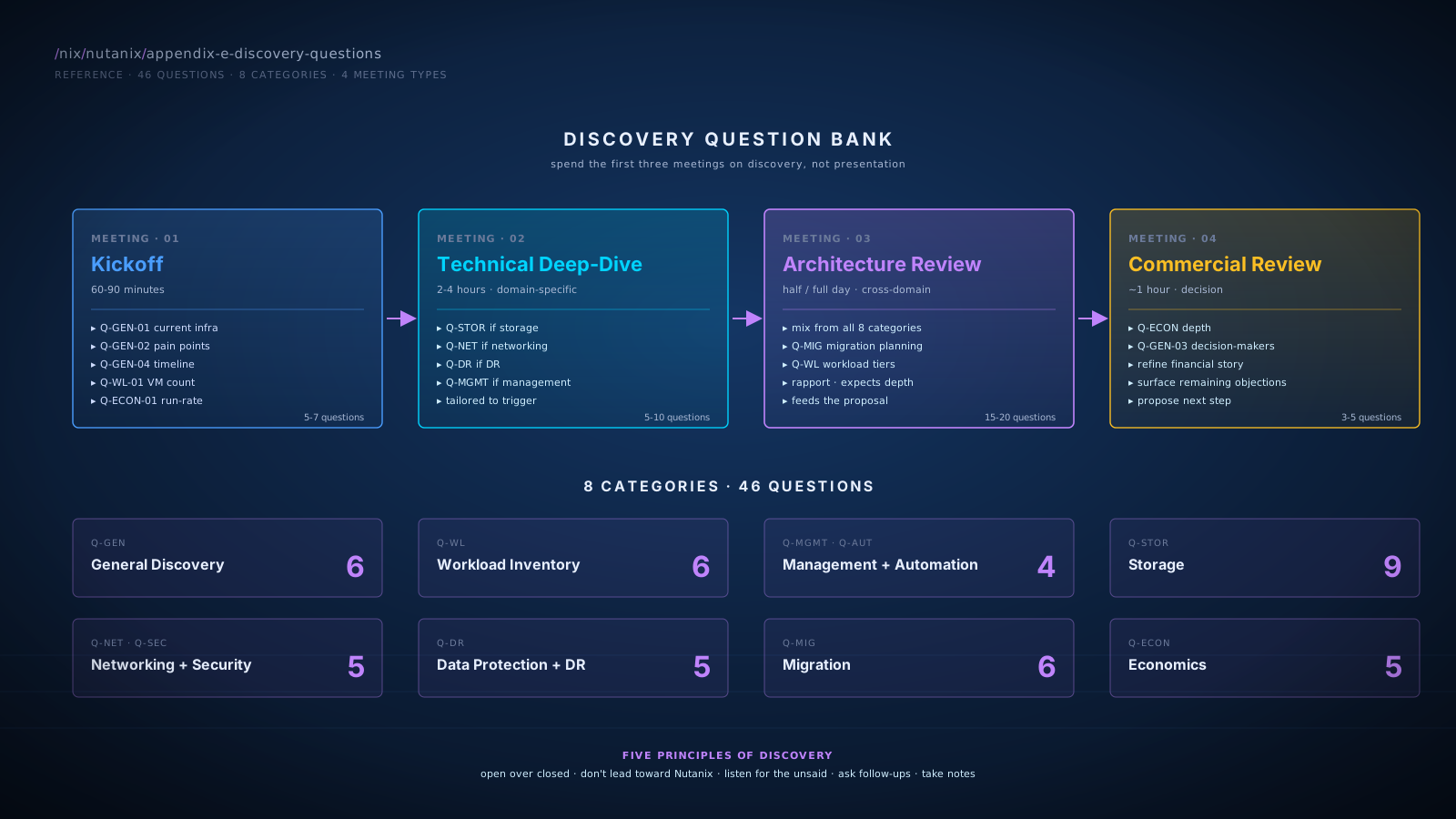
How to Sequence Discovery
First customer meeting (Kickoff, 60-90 min)
Cover the foundation. Pick from:
- Q-GEN-01 current infrastructure
- Q-GEN-02 pain points and triggers
- Q-GEN-04 timeline and refresh
- Q-WL-01 VM count and distribution
- Q-ECON-01 annual run-rate (light touch)
- Q-MGMT-01 current management stack
This establishes the situation. Don't dive deep yet.
Second meeting (Technical deep-dive, 2-3 hours)
Tailor to what surfaced in kickoff. If storage was the trigger, pick from Q-STOR. If DR is the trigger, pick from Q-DR. If networking, Q-NET. If economics, Q-ECON.
Third meeting (Architecture review, 4-6 hours or full day)
Comprehensive cross-domain. Pick 15-20 questions across all categories. By this meeting, you have rapport; the customer expects depth; the answers inform the proposal.
Fourth meeting (Commercial / decision)
Q-ECON depth. Q-GEN-03 (decision-makers). Refine the financial story. Surface any remaining objections.
What to Do With the Answers
After every discovery session:
- Update the customer notes. Specific quotes are valuable; capture them.
- Update the risk register. What did this session surface?
- Update the proposal scope. What changed about what we're recommending?
- Identify follow-up questions. What new questions does this answer raise?
- Identify follow-up actions. Documents to send, references to share, technical validations to schedule.
Discovery is a continuous process, not a one-time intake. The discovery you do in week 1 informs the proposal in month 3, the design in month 6, and the operational handoff in month 18.
References
This appendix is engagement methodology (questions to ask, what to listen for, what to do with the answers); it intentionally avoids restating technical specifications. The technical content underlying the questions (RPO/RTO definitions, NSX-T footprint, SRM customization, NCI/NCM tiers, Files/Objects use cases) is sourced and verified in the per-module References sections:
- Module 4 · Aria footprint, identity, automation. Backs the Q-MGMT and Q-AUT question domains.
- Module 5 · IOPS/latency profile, capacity, RF/EC. Backs Q-STOR-01 through Q-STOR-05.
- Module 6 · NSX-T, microsegmentation, VPC. Backs Q-NET-02 through Q-NET-04.
- Module 7 · RPO/RTO, SRM, DR test cadence. Backs Q-DR-01 through Q-DR-05.
- Module 8 · Files / Objects / Volumes inventories. Backs Q-STOR-06 through Q-STOR-09.
- Module 9 · Run-rate, decision-makers, refresh timing. Backs Q-ECON and Q-GEN-03 / Q-GEN-04.
- Module 10 · Migration discovery, dependency mapping. Backs Q-MIG-01 through Q-MIG-06.
Cross-References
- Modules: Each question links to the module where the topic is taught in depth.
- Glossary: Appendix A defines the terms used in the questions.
- Comparison Matrix: Appendix B supports the answers customers give.
- Scenarios: Appendix C shows how discovery answers feed into design exercises.
- Objections: Appendix D has the responses to objections that emerge from discovery answers.
- POC Playbook: Appendix J has the demo flows that often resolve technical questions faster than discussion.